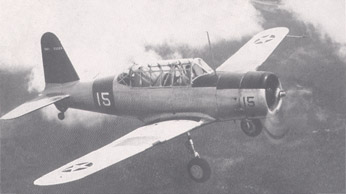
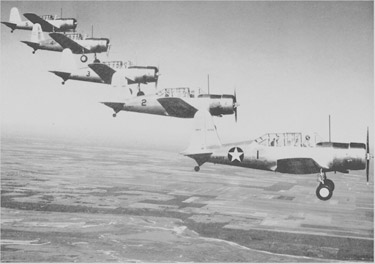
After flying N3's for a little more than a week, Guy began flying the SNV-1 aka the Vultee BT-13 Valiant about November 21.
Doc Marker, also a Cadet at Corpus at the time, recalls:
"The first aircraft we flew at Corpus was the SNV. This was a natural progression from the Stearman, going from the bi-wing to the low wing, retaining the fixed landing gear but adding two other elements, radio,manual flaps and a two position prop. After one or two flights I felt right at home in the aircraft and really began to feel like I might make it as an aviator. The next step was formation flying in the SNV and as this airplane had great visibility, was very stable and not at all tricky on the controls, it was the ideal craft for such training."
SNV-1
Guy's comments on instrument flying, Christmas, and application for the Marine Corps:
"You were asking about my coming home Christmas. Well, as much as I'd like to I'm afraid it's quite impossible. I'm in instrument flying now and we're busier than ever. We get up at 6:00 and stay in absolutely the maddest rush until 10:00 you ever saw. Instrument stage is by far the toughest stage of all because it requires so very much. Many Cadets have had nervous breakdowns at this stage.
You see, you sit in a plane with a black hood completely covering you and the cockpit and keep your eyes glued on the instruments hour after hour, day after day. And when a day is over, you feel as though that morning was a year ago.
You see, we do everything by instruments, even take-off. We climb by the climb indicator, tachometer, airspeed indicator, we cruise by the airspeed, rpm, artificial horizon, and tabs. We bank and turn by the artificial horizon, needle and ball, degree of bank with horizon indicator, altimeter, airspeed, and tabs. We set and change our courses by the directional gyro which is checked and corrected after each turn, etc. with the magnetic compass. When flying descent, you have to change the prop pitch and tabs and about a dozen other things. Then on top of all of that, the whole time you have earphones on which is sending out different beams. You have to fly certain patterns through and around these beams by the code coming over the phones. Your landing approaches, etc. and all the other stuff I named is done under the hood entirely by instruments. By the end of a day, you're not only physically dead, but you're absolutely worn to a frazzle due to being on your toes every second of the day.
Sometimes I think how simple it would be to go to college after the war and getting three degrees in one year. It would be simple after this - no lie.
Well, as I was saying, I'm sure it will be quite impossible to get away from here. We're flying now seven days a week. And there's talk that we'll fly even Christmas Day. But I hope we don't. I'd like at least one day off during this month of instruments. It would sorta' give me a chance to draw an easy breath. ..... ... I put in my application for the Marine Air Corps today. My training until I get my commission will be the same, then after that I'll get training in all the Army and Navy planes. The Marines use both. I'll let you know more about it when I find out if I'm accepted. It's really a nice set-up."