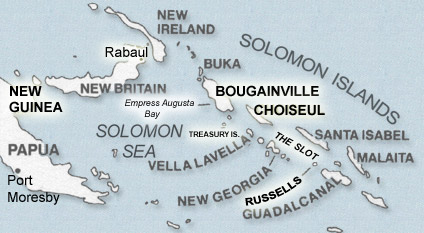
Background From the beginning, Japanese strategy had been to migrate their forces through the South Pacific to control the sea lanes to Australia and New Zealand.
Once this could be accomplished, these acquisitions would contribute greatly to their need for more resources to bolster their continuing advances elsewhere.
By August 1942, Japan's reach spanned from Burma to the East, to the Aleutian Islands to the West, and to New Guinea to the South.
To stem this advance, MacArthur devised the Elkton plan as a strategy to take Rabaul, a Japanese Air and Naval stronghold, from bases in New Guinea and Australia.
After Guadalcanal had been taken in December 1942 and the Russell Islands in February 1943, he revised his plan to Elkton III to take Rabaul before before 1944.
MacArthur, in collaboration with the Joint Chiefs, modified this plan to become Operation Cartwheel. Operation Cartwheel, comprised of 13 separate operations,
proposed proceeding North climbing the Solomons "ladder" island by island to repress Japanese advance and ultimately take or isolate Rabaul.
Operation Cartwheel commenced on June 30, 1943 with Operation Chronical to take Woodlark Island and Kiriwina, the largest of the Trobriand Islands. This strategy was due
largely to a shortage of available aircraft carriers, thus making it necessary to go from island to island utilizing existing airfields or constructing new ones in order to continually extend the reach of bombers, fighters, and other air power.
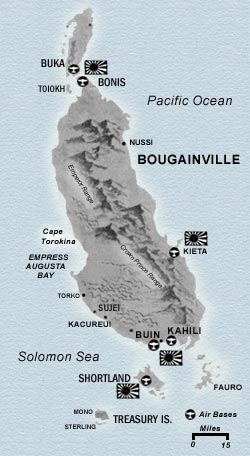
Bougainville Key to this effort was Bougainville at the most northern of the Solomons. Rabaul, a principal Japanese air and naval base,
was only 235 miles to the Northeast of Bougainville. This would be an acceptable range for fighter attacks.
Though fighter attacks on Bougainville had begun in August 1943, these were intensified by Marine, Navy, Army, and New Zealand
MacArthur
air forces during October as D-Day for the Operation Cherryblossom landing scheduled November 1, 1943. These strikes included neighboring islands in order to
mask the actual landing location. Meanwhile, MacArthur was planning an assault on Cape Glouster at the western end of New Britain for the following month. This would
allow air attack on Rabaul from two directions and eventually isolate the approximately 90,000 Japanese troops there. Just day prior to D-Day, two diversionary
amphibious landings were made at night on Choisuel to the East and on the Treasury Islands to the West. These operations successfully drew Japanese forces away from
Bougainville.
Halsey
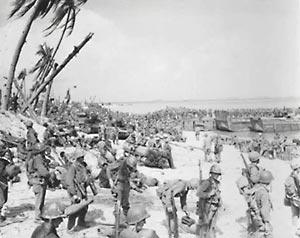
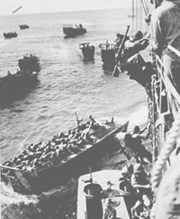
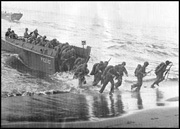
On D-Day, November 1, the 3rd and 9th Marine Divisions and the 2nd Raider Regiment moved ashore at Empress Augusta Bay in a first wave attack at dawn. Task forces
comprised of four cruisers and eight destroyers ordered by Admiral Halsey
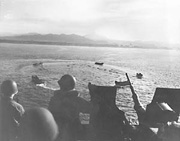
Landing craft circle. Mountains of Bougainville are on the horizon.
bombarded airfields on Buka and Bonis to the Northwest of Bougainville. This served to distract enemy air resistance from the landing force.The American ships also
intercepted enemy ships sinking two and damaging two others forcing the enemy to retreat.
Despite a heavy surf and heavy enemy fire, a beachhead was made.
Progress for expansion would prove slow as swamps and dense jungle would pose as great a challenge as the enemy. Two Japanese air assaults from Rabaul bases
were repulsed by AirSols (Air Solomon) fighters. By evening, a force of
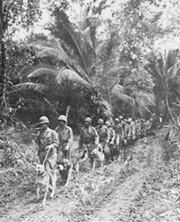
14,000 troups had landed along a 200 yard perimeter which included the 1st Marine Dog Platoon with 24 Dobermans and German shepards. The troops had arrived in 12 transports
preceded by a minesweeper group. However, after three days a perimeter of only 1,500 yards from the beach. Marines continued very slowly inland finding snipers and other
Japanese resistance dug into mountains and jungle waiting for their advance. On November 11, one Navy task force destroyed three enemy ships and 68 fighters.
Despite this, Japanese carriers from Rabaul made attacks on the Marine landing force and Navy ships. Though little damage was made on U.S. troops, the Japanese then lost 121
planes causing their carriers to withdraw within two days.
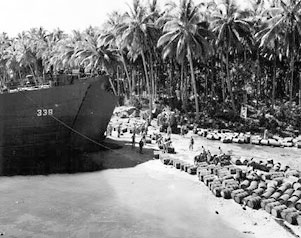
Torokina Field By mid-November, 34,000 troups with over 23,000 tons of supplies had landed on
Bougainville with a beachhead now of 7,000 yards and 5,000 yards into dense, difficult mangrove swamps. Eight Seabee battalions and one New Zealand engineer brigade had
begun construction of two airfields.
The first airfield would be a fighter strip, Torokina Airfield (off Cape Torokina), and, later, Piva. Despite remote shelling from the Japanese, Seabees continued
construction day and night enabling the fighter airfield, Torokina, to be operational by December 10th.
The first fighter squadron to land on the newly completed strip would be VMF-216.
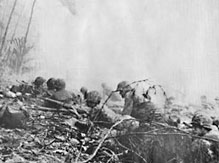
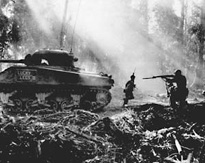
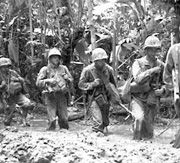
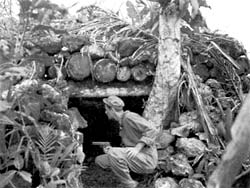
Marines in Combat on Bougainville
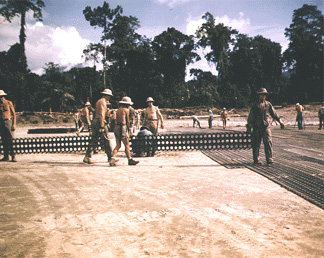
Seabees lay Marston matting for Torokina Airfield
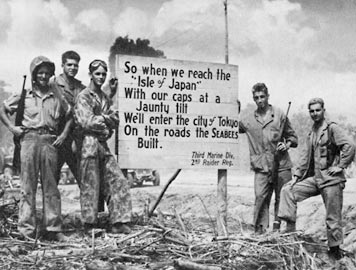
Tribute to the SEABEES
From the Third Marine Division, 2nd Raider Regiment





 were repulsed by AirSols (Air Solomon) fighters. By evening, a force of
14,000 troups had landed along a 200 yard perimeter which included the 1st Marine Dog Platoon with 24 Dobermans and German shepards. The troops had arrived in 12 transports
preceded by a minesweeper group. However, after three days a perimeter of only 1,500 yards from the beach. Marines continued very slowly inland finding snipers and other
Japanese resistance dug into mountains and jungle waiting for their advance.
were repulsed by AirSols (Air Solomon) fighters. By evening, a force of
14,000 troups had landed along a 200 yard perimeter which included the 1st Marine Dog Platoon with 24 Dobermans and German shepards. The troops had arrived in 12 transports
preceded by a minesweeper group. However, after three days a perimeter of only 1,500 yards from the beach. Marines continued very slowly inland finding snipers and other
Japanese resistance dug into mountains and jungle waiting for their advance.